


Franchise eCommerce Platforms: 5 Strategic Marketplace Models
Franchise networks that don't sell online fall behind. For independent retailers, the decision is straightforward. But bringing a franchise network of dozens or hundreds of partners into e-commerce raises harder questions.
The franchise model runs on independent business owners selling under a shared brand with a shared product range. What works offline (stores are separated by geography and don't cannibalize each other) collapses online. The web has no geographic boundaries. Ten franchise partners running ten separate webshops under the same logo don't strengthen the brand. They fragment it.
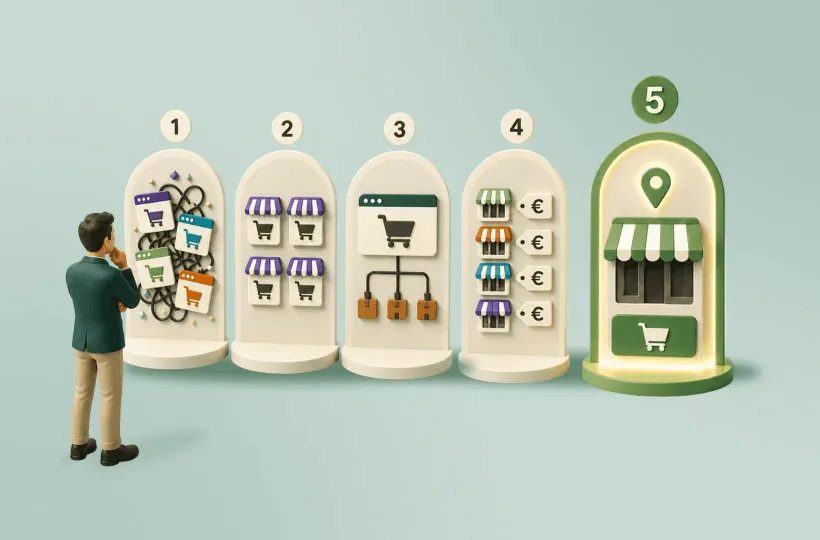
Below are five models a franchise network can use for online sales, with pros, cons, and our experience with each. At the end, we show which model offers the best compromise for most networks.
Approach 1: Independent Online Stores
How does it work?
The simplest scenario: every franchise partner decides on their own whether to build a webshop, and if so, what kind. Everyone picks their own platform, design, developer, and hosting.
From the customer's perspective
The customer searches for something, lands on one partner's webshop (via Google, ads, or social media), and places an order. That partner handles delivery.
Pros
Maximum freedom for partners: everyone can pursue their own vision, experiment, and innovate.
No cost to headquarters: development, operations, and marketing fall on the partners.
Cons
This model creates serious problems in practice:
Fragmented brand experience: Picture a building materials franchise where one partner sells through a polished modern webshop on mybrand.com, another runs a 2015-era template on buildingsupplystore24.com, and a third has a Facebook page. The customer doesn't see a franchise brand. They see a mess.
High costs for everyone: Every partner has to purchase, integrate, and operate an e-commerce solution on their own. For smaller partners, this is often unaffordable.
Partners advertise against each other: On Google Ads and in SEO, partners bid against each other for the same keywords. Cost-per-click rises for everyone, and even the "winner" gains no organic traffic. They pay more for the same result.
Legal compliance gaps: Online retail is regulated (GDPR, consumer protection, right of withdrawal, terms and conditions). When every partner handles their own compliance, some will fall short, and that damages the franchise brand's reputation.
Who might this work for?
Networks with two or three partners, where those partners are strong enough to handle it, and headquarters has chosen to stay out of online sales.
Approach 2: Unified eCommerce Template
How does it work?
Headquarters develops a shared e-commerce solution that every partner can use. This might be a customizable template, a SaaS-style solution, or a shared platform with individual subdomains (e.g., boston.brandname.com, chicago.brandname.com).
From the customer's perspective
Similar to the first approach: the customer finds one partner's webshop and orders from there. The difference is that all webshops look and function the same way.
Pros
Consistent brand experience: Every partner's webshop looks identical and offers the same features. The customer gets the same quality everywhere.
Central legal compliance: Headquarters ensures that terms and conditions, privacy policies, and withdrawal rights are handled correctly across the board.
Lower cost per partner: One development effort shared across many partners. The per-unit cost is a fraction of a custom solution.
Faster launch: A new partner can be online in days or weeks, not months.
Cons
Still a fragmented online presence: If 50 partners have 50 webshops, even identical ones, that means 50 separate domains, 50 Google indexes, 50 marketing budgets. The brand's power gets diluted.
Partners still compete with each other: Google search doesn't differentiate between brandname-boston.com and brandname-chicago.com being part of the same network. They bid against each other.
High IT maintenance costs for headquarters: Developing, maintaining, updating, and supporting the shared platform takes significant resources.
Who might this work for?
Networks where headquarters has strong IT capabilities, but partners insist on their own webshop identity (their own URL, their own communications). This is better than Approach 1, but it leaves several problems unsolved.
Approach 3: Centralized eCommerce Platform
How does it work?
Headquarters develops and operates a single webshop. Partners have no independent online sales channel. The franchise agreement prohibits creating separate webshops, as they would compete with the shared platform.
Headquarters distributes incoming orders among partners (often based on delivery address), or splits revenue according to an agreed formula.
From the customer's perspective
The customer visits the brand's single website, orders products, and a franchise partner fulfills the delivery. The customer doesn't know which partner, and doesn't care.
Pros
One brand, one webshop, one marketing budget: No cannibalization, no competition between partners. The full online marketing spend strengthens a single website.
Full brand control: Headquarters manages the customer experience, product presentation, and pricing.
Cons
Order allocation is politically charged: How do you decide which partner fulfills an order? Delivery address seems logical, but what if multiple partners operate in the same area? What if online orders run far higher in some regions?
Revenue sharing breeds conflict: No matter how you divide it, some partners will feel shortchanged. This tension is constant.
Hard to pitch to partners: Franchise partners are independent business owners. Telling them "you can't run your own webshop, but headquarters will send you orders" requires trust that many partners won't extend.
Legal constraints: Not every franchise agreement allows headquarters to prohibit partners' independent online sales. The legal framework needs careful examination.
Who might this work for?
Networks where headquarters holds a strong bargaining position, partners accept centralized control, and franchise agreements permit it. This is rare. In most franchise networks, partner autonomy is a founding principle.
Approach 4: A Traditional Marketplace
How does it work?
Headquarters operates a traditional marketplace where all partners appear as sellers. The customer sees which partner offers each product and can choose between them, similar to how multiple sellers offer the same product on Amazon or eBay.
From the customer's perspective
The customer visits the brand's website, selects products, and for each product decides (or the system decides) which partner to buy from. Orders from multiple partners mean multiple separate deliveries.
Pros
One platform, shared advertising: The marketing budget strengthens a single platform with no fragmentation.
Central control over brand experience and legal compliance.
One integration for every partner: Development and operating costs are shared.
Cons
This model is deeply problematic for franchise networks, and in most cases counterproductive:
Price wars between partners: When every partner offers the same product (which is almost always the case in franchise networks), customers choose on price alone. This starts a downward price spiral that erodes everyone's margins.
Confusing customer experience: The customer buys from one brand, so why do they receive three packages from three partners? On Amazon, buyers expect that. For a franchise brand, it's baffling.
Hard to implement: Partners see at once that this model makes them direct competitors. Getting them to sign on is a fight.
Who might this work for?
Almost never for franchise networks. The traditional marketplace works when sellers offer different products (like a shopping mall). When everyone sells the same thing, the model erodes itself.
Approach 5: Franchise Marketplace Platform
How does it work?
This model combines the strongest elements of the traditional marketplace and the central webshop. Headquarters operates a single platform where all partners are present, but the customer first selects a partner, then shops from that one "store."
This is how Wolt and DoorDash work. You open the app, pick a restaurant, and order from there. You don't mix items from three restaurants. One restaurant, one order, one delivery.
From the customer's perspective
The customer visits the brand's website. Based on browser geolocation or a provided address, the system suggests the nearest franchise partner. The customer accepts the suggestion (or picks a different one), and from that point the experience works like a traditional online store: product selection, cart, checkout, one delivery.
The geolocation-based partner selector
The key element of the franchise marketplace is a partner selector that follows this logic:
Automatic location detection: The system identifies the customer's location via browser geolocation or a provided zip code and suggests the nearest partner that can deliver.
Delivery zone management: Every partner has a defined delivery area. The system only offers partners who can deliver to the given address.
Inventory availability: If the nearest partner is out of stock on a product, the system suggests the next available partner, with no friction for the customer.
In-store pickup: The partner selector doubles as a store locator. If the customer prefers pickup, the system suggests the nearest physical location.
Pros
One brand, one platform, shared marketing: The full online presence strengthens a single website. SEO, advertising, and content marketing concentrate in one place.
No price competition between partners: Since the customer buys from one partner (rather than comparing partners product by product), there's no downward price spiral. Margins hold.
Simple, familiar customer experience: After selecting a partner, the flow is identical to a traditional online store. One cart, one payment, one delivery.
Central control over brand, quality, and legal compliance: Headquarters ensures uniform terms, privacy compliance, and consumer protection.
Fast onboarding: A new partner can be online in days. The platform is already built; only the partner needs configuration.
Attractive for partners: Partners keep their own customers, revenue, and business autonomy without developing or operating their own webshop.
Cons and challenges
More complex to build than a standard webshop: Multi-tenant architecture, the partner selector, delivery zone management, and varying inventories all add complexity.
Choosing the right technology partner matters: Few technology partners have real experience building franchise marketplaces. Standard e-commerce platforms (Shopify, WooCommerce, Magento) don't support this model out of the box. Custom development or a specialized solution is required.
Hybrid Solutions
Many franchise networks combine approaches, especially during transition. For example:
Headquarters operates the franchise marketplace, but partners run local social media and Google Ads campaigns that drive traffic to the shared platform.
Key partners (e.g., those with large territorial coverage) get additional features within the platform.
This works fine. What matters is that the core platform stays unified and additions don't compromise the brand experience.
How Do You Measure Success? KPIs by Model
The table below shows which metrics to track for each model, and where to expect strengths or weaknesses:
Criterion | Approaches 1–2 (Independent / Unified eCommerce) | Approach 3 (Centralized eCommerce Platform) | Approach 4 (Traditional Marketplace) | Approach 5 (Franchise Marketplace Platform) |
|---|---|---|---|---|
Consistent brand experience | Weak to moderate | Excellent | Moderate | Excellent |
Marketing cost per partner | High (everyone on their own) | Low | Low | Low |
New partner onboarding time | Months | Not applicable | Weeks | Days to weeks |
Margin preservation | Varies | Centrally priced | Destructive price wars | Preserved |
Conversion rate | Varies | High | Low (complex UX) | High |
Legal compliance | Partner-dependent, risky | Centrally ensured | Centrally ensured | Centrally ensured |
Franchise partner satisfaction | High (freedom) | Low (no input) | Low (price wars) | High (autonomy + support) |
Summary: Which One Should You Choose?
If you're planning online sales for a franchise network, the franchise marketplace model (Approach 5) offers the best balance:
For headquarters: unified brand, control, lower per-unit costs, legal compliance.
For franchise partners: no webshop development or operating costs, no cannibalization, business autonomy preserved.
For customers: a simple, familiar experience, like ordering on DoorDash.
Implementation isn't trivial: multi-tenant architecture, geolocation-based partner selection, delivery zones, inventory management, and partner onboarding all require an experienced technology partner.