


2025 AI tech outlook
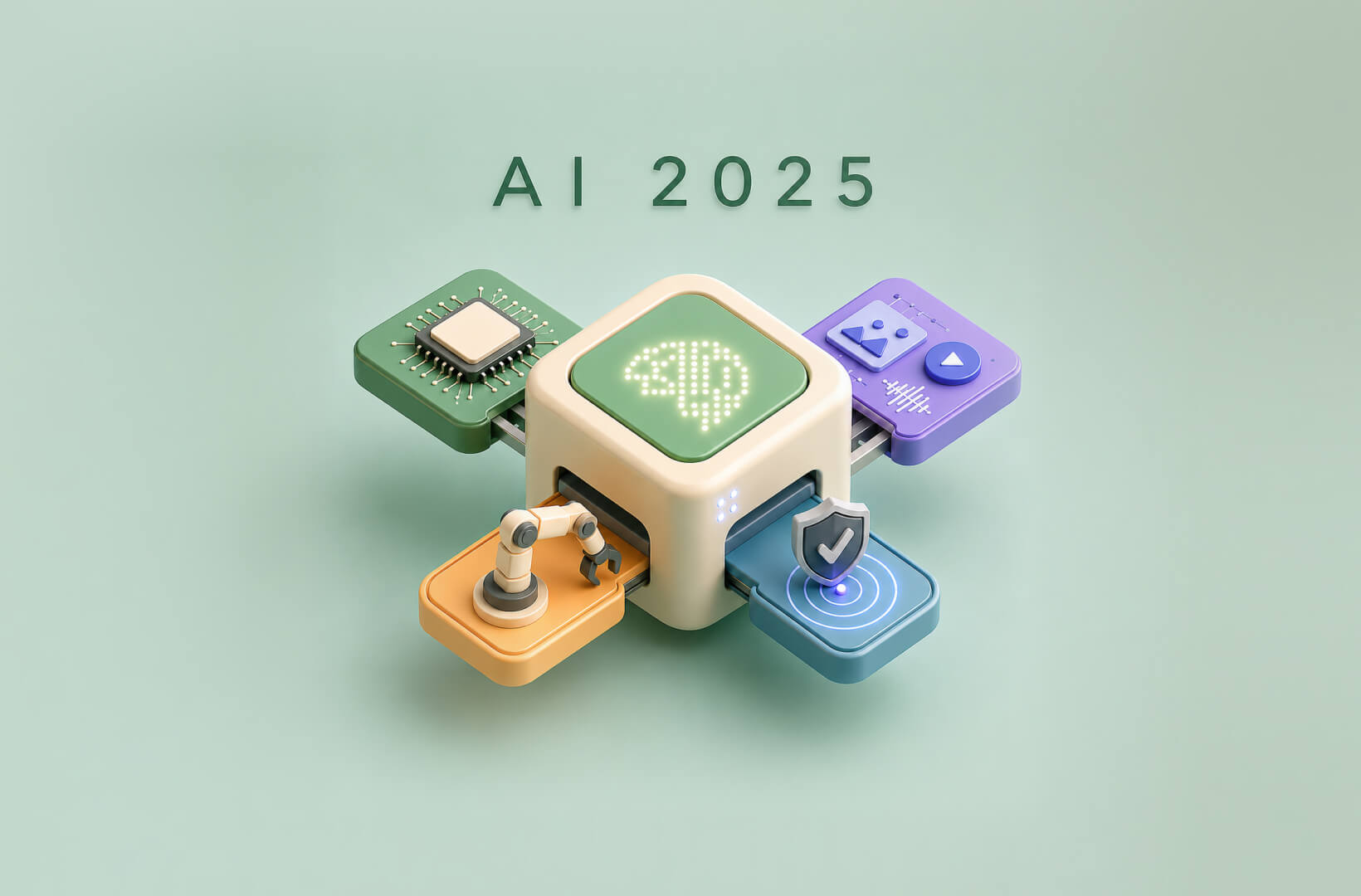
What role will AI play in 2025? From innovative hardware like NVIDIA's Blackwell GPUs to major advances in autonomous AI agents and proactive monitoring systems, these advances are transforming industries and redefining technology. Discover how these developments are setting new standards for the efficiency, adaptability and ethical application of AI.
Artificial intelligence trends for 2025 highlight a rapidly changing landscape, with improvements in AI hardware enabling real-time processing on mobile and IoT devices. Autonomous agents and multimodal capabilities are revolutionising healthcare and customer service, while proactive AI monitoring promotes fairness and reliability, building trust in these advanced systems. This article explores the AI trends that are shaping the future and looks at how advances in data AI technologies are continually redefining what's possible in different sectors.
1. AI hardware evolution: a new era
AI hardware is on the verge of a major transformation in 2025. The rise of edge computing drives the development of compact, energy-efficient chips that enable real-time AI processing on mobile and IoT devices, reducing reliance on cloud services and improving data privacy. NVIDIA's Blackwell GPUs, such as the B200 and GB200 models, are poised to set new benchmarks for generative AI and high-performance computing. Although there are manufacturing challenges that keep demand for H200 GPUs high, the Blackwell architecture is expected to significantly influence trends in artificial intelligence for both training and inference. Competitors such as Broadcom are also accelerating innovation in power efficiency and performance optimisation, making AI applications more accessible across various devices.
2. AI agent development and multimodal integration
Autonomous AI agents are changing the way tasks are performed by adapting to changing conditions and managing complex workflows with ease. These agents are improving decision-making and streamlining operations across industries, making them essential for both personal and professional applications.
Smaller, task-specific AI models increase efficiency and sustainability by minimising computational requirements while excelling in specialised areas. The ability to process text, images, audio and video simultaneously is enabling AI to facilitate intuitive interactions in areas such as customer service and immersive XR environments.
These advances set the stage for AI trends in 2025, highlighting the increasing importance of specialised models and sophisticated data handling in AI.
3. Transforming AI monitoring: proactive monitoring
AI monitoring is evolving from simply reacting to problems to actively managing them. Real-time tools now monitor metrics such as latency, data drift and fairness, enabling rapid problem resolution. Sophisticated testing frameworks replicate complex scenarios to ensure robustness, fairness and reliability in critical areas such as healthcare and finance.
Model drift detection systems, coupled with automated retraining pipelines, maintain continuous accuracy and adaptability. This proactive strategy for AI trends cultivates a trusted environment, upholds ethical standards and builds trust in data-driven AI systems.
4. OpenAI's o3: Adaptive AI redefined
OpenAI's o3 model brings a new level of dynamic reasoning, enabling AI to create and follow logical paths in real-time. Its impressive performance on the ARC AGI benchmark, up to 87.5% with enhanced computational resources, demonstrates its ability to handle complex and novel tasks. This breakthrough places OpenAI at the forefront of AI trends, providing valuable solutions for scientific research, algorithm development and educational applications. Although it requires significant computing power, the expected improvements in efficiency will make o3 more widely available, representing a major step forward in artificial intelligence trends for 2025.